A veterinary pathologist from Italy has become a central and broadly respected member of the Australian academic community, thanks to her equal dedication to the animal and human kingdoms. Chris Sheedy reports

Many in the veterinary and medical world have heard of the One Health Initiative, a worldwide strategy that encourages and expands interdisciplinary collaborations across the spectrum of human care, animal care and the environment. The synergies achieved are expected to accelerate new discoveries, enhance public health efficiencies and improve medical education and care for humans and animals. Although the idea of a single, interconnected health ecosystem encompassing humans, animals and the environment dates back to the ancient Greeks, it is a concept that has only recently been organised into a movement, one still gaining traction.
But ever since the beginning of her career, in the early 2000s, this is the only way that Associate Professor Chiara Palmieri has understood medicine to operate. Now a veterinary pathologist working since 2012 within the School of Veterinary Science at the University of Queensland, and the president of the Australian Society of Veterinary Pathologists, the Italian national also considered studying for human medicine as well as dentistry before settling on veterinary medicine.
“I loved medicine in general, but what brought me to vet science was the idea that it’s more exciting than being a human doctor, since you have different species with different biologies and anatomies and functions and behaviours,” she says. “So it’s more challenging and more exciting to deal with animals compared to humans. And, of course, when you are in vet science, it doesn’t mean your work is different to human medicine, since animals can be models for human diseases.”
A/Prof Palmieri grew up on the Adriatic coast of Italy and had several pets as a youngster. But it was an experience later in life, when she first began studying at the University of Teramo, that influenced the direction of her study. Her father suffered prostate cancer and the realisation of the enormity of the problem in men sent her work in a specific direction.
“I have different research interests, but my main area is small animal oncology and specifically prostate cancer,” A/Prof Palmieri says. “I began to study prostate cancer in dogs when I realised what a big issue it is in men. I thought, since dogs are the only animals in which prostate cancer continuously occurs, it would be interesting to study prostate cancer in them in order to translate those results to human medicine. So, it was a personal drive. I’m interested in other cancers as well, and in other things such as bird pathology or koala diseases, but mainly it’s the comparative features of small animal cancer that I’m very interested in.”
Right now, the 37-year-old is involved in canine osteosarcoma and prostate cancer research projects, as well as other studies including one on koalas and chlamydia and another on avian pathology, with a collaborator in the US. The koala project is a great example, she says, of the value of travelling and working in different parts of the world.
Her original degrees, including a PhD in ultrastructural pathology in 2006, were completed in Italy, including a residency program at the School of Veterinary Medicine in Milan. A/Prof Palmieri has also studied and worked in Prague, at the Institute of Animal Production, and in the US at the California Animal Health and Food Safety Laboratory System.
“I loved medicine in general, but what brought me to vet science was the idea that it’s more exciting than being a human doctor.” Associate Professor Chiara Palmieri
“One of my friends was moving to Australia,” she says. “She was working at the University of Melbourne and told me about the opportunity to move. There were a few positions available, and I knew UQ [University of Queensland] was one of the best universities in the world for vet science. But really I wanted to move to have a different perspective on my work, to see different cases by working in a different environment. I wanted to experience different points of view to achieve more of a 360-degree view of veterinary pathology.
“So, I moved in 2012 to improve myself and my job, to get an opportunity to join a good university with a good reputation and to have the opportunity to do different things. Veterinary pathology is a very broad topic and there are different species here. While I was in Italy, those species were exotic, but now I’m dealing with koalas, with marsupials, monotremes and other species, so it’s quite exciting. It’s a very good experience.”
There’s also a greater independence for the researcher in the Australian academic system compared to Europe, says A/Prof
Palmieri. It’s easier in Australia to build up your own research team and to collaborate with people from various departments, for example, although both systems have their benefits.
A/Prof Palmieri’s experiences with small animals have also helped, in a surprising way, with her latest adventure—motherhood. She recently gave birth to her first child, a girl, and has received compliments from other mums who admire her understanding of her baby’s moods.
“I was talking to one of my friends yesterday and I told her that babies are like animals because they don’t speak at all,” she says. “She was very impressed with my attitude towards the baby, and that I was not freaking out while my baby was screaming or crying. But I am used to communicating with animals and trying to understand their needs. They are very similar. You need to be patient with animals and with babies. You need to understand the ways that they try to communicate with you. So, I think that being a vet, in this sense, has helped me a lot with my baby.”
Not that she has ever actually practised as a vet. A/Prof Palmieri says she doesn’t believe she would be very good when it comes to clinical examination, although her experience with the anatomy of various animals, and with post-mortem examinations, would likely mean she would make a great surgeon.
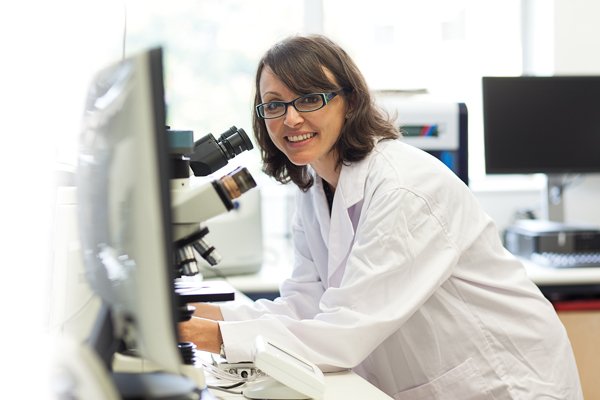
But the arena of academic research is where A/Prof Palmieri has found her true calling. Her research interests include reproductive pathology encompassing canine prostate and testis cancer, female genital system pathology and infertility in farm animals. She has also looked into the evaluation of pregnancy losses and placental abnormalities associated with assisted reproductive techniques, the ultrastructural characterisation of neoplastic diseases in domestic animals, male reproductive pathology induced by chlamydia infection in koalas, and avian pathology.
Her work has a large and appreciative audience of academics, researchers and pet owners. A/Prof Palmieri has had 37 papers published in international journals. She regularly travels the world to speak at events, including an upcoming trip to Italy to present to the Italian Association of Veterinary Pathologists.
What is she most proud of so far in her relatively short but enormously impressive career? One study A/Prof Palmieri remembers with great satisfaction was around the topic of placental lesions, she says. The work was based around what was going on in pregnancies resulting from assisted reproductive techniques. What are the pathologies associated with these pregnancies, etc? It led on to a great deal of further research and, as a result, a new chapter of knowledge in vet science.
“In the first part of my career, during my PhD and for a few years after, I was mostly focusing on pathology associated with assisted reproductive techniques, and I’m very proud of this part of my research,” she says.
“What I have in mind these days is a big picture, in which there’s a link between pets and humans. This is what’s driving my research. Of course, if you’re studying causes or effects of specific diseases in animals, then your work is important for animal owners, for the pet’s health and for developing better therapies. But the most important thing driving my research is linking the medical knowledge we have of animals and of humans. We really can look at pets to learn more about treating human diseases.”
A/Prof Palmieri, then, is a veterinary pathologist who is not just interested in finding better therapies for animals, but is also hoping to add to that knowledge by using it to better understand the causes, effects and treatments of human diseases. Her research, originally kickstarted by her father’s illness, is now being driven by the translational side of the knowledge she is producing. It is being driven by the fact that the results of her work can actually help to create better tools, processes, drugs, education and policies around the treatment of both human and animal diseases.
“The One Health concept talks about medical issues affecting both humans and animals,” she says. “Everyone now knows how important it is to study animals and to discover things in animals in order to find out important information about humans as well.”
And A/Prof Palmieri says that in today’s academic world, where the time frame from research project to practical application was once measured in decades, real outcomes for the industry can sometimes be achieved just three years after the launch of a research study.
“It depends on the type of research and the types of diseases, but four to five years is the minimum, I think,” she says. “But everything starts from research and only after that is done can we seek the practical application of that research, which is so important for vets and for pet owners. Considering the potential translational importance to human medicine, this is a very interesting field to be working in.”